
Till Death Do Us Part
On Marriage and the Resurrection

For in the resurrection they neither marry, nor are given in marriage, but are as the angels of God in heaven. But as touching the resurrection of the dead, have ye not read that which was spoken unto you by God, saying, I am the God of Abraham, and the God of Isaac, and the God of Jacob? God is not the God of the dead, but of the living. And when the multitude heard this, they were astonished at his doctrine.
Matthew 22:30-33
The crowd was right to be astonished at his teaching. Jesus’ saying is one worthy of many questions. In writing on this passage my aim is not to answer these questions, but to uncover their depth. In particular, I have two questions in mind: Why is there no marriage in the resurrection? What does it mean to be “like the angels”?
To explore the first question, we need an understanding of marriage. The second chapter of Genesis outlines the structure of marriage for us: “Therefore shall a man leave his father and his mother, and shall cleave unto his wife: and they shall be one flesh.”1 Since the beginning of man and woman, it has been customary for man to leave his family of origin and bind himself to his wife in the flesh. We continue to symbolize the binding of man and woman with a ring, worn on the finger.
The ring is a symbol of binding not only in the domain of the family, but also in the domain of law. The king’s ring bears his seal, and the seal makes his decree binding, as we read in the book of Esther:
“Write ye also for the Jews, as it liketh you, in the king’s name, and seal it with the king’s ring: for the writing which is written in the king’s name, and sealed with the king’s ring, may no man reverse.”2
From these examples, we see that the pattern of binding can be either good or bad. In the case of marriage it is beautiful, and in the case of a slave or criminal it is dreadful. I will limit myself here to the specific pattern of marriage, as the general pattern of binding (and the ring) would require a lengthier examination.
However, we must link the pattern of marriage to that of law. Marriage was codified in the law on Mt. Sinai, finding a place in the Ten Commandments: “Thou shalt not commit adultery… Thou shalt not covet thy neighbour’s house, thou shalt not covet thy neighbour’s wife.”3 Divorce, too, was regulated by the law given on Sinai.
Now it is characteristic of Jesus (and also of Paul), to rise above the law.
To Moses, the law was given: “Whosoever shall put away his wife, let him give her a writing of divorcement.”4 But Christ goes beyond the law, even strengthening the bondage of marriage: “but I say unto you, that whosoever shall put away his wife, saving for the cause of fornication, causeth her to commit adultery.”5 In other words, the bonds of marriage cannot be broken by any means but adultery (whether it be legal or illegal, it remains adultery).
This is the core context of our examination, and it is the context of the riddle which the Sadducees pose to Jesus:
“Master, Moses said, If a man die, having no children, his brother shall marry his wife, and raise up seed unto his brother. Now there were with us seven brethren: and the first, when he had married a wife, deceased, and, having no issue, left his wife unto his brother: likewise the second also, and the third, unto the seventh. And last of all the woman died also. Therefore in the resurrection whose wife shall she be of the seven? for they all had her.”6
Now we can see clearly the appeal to the law in the riddle: “Master, Moses said…” It involves one woman and seven men who followed the law with no violation. The problem is due to time and death. What is allowable (even required) in the passage of time and because of death, is a series of bindings. In the resurrection, when the seven bindings become “active” at once, which one takes precedence? Shall she be bound to the first or the last? Or torn into seven pieces? It seems that resurrection turns the woman into an adulteress. On this basis the Sadducees reject the resurrection, as it apparently contradicts the law.
Perhaps the most straightforward answer to this riddle is given by Paul in his letter to the Romans: “Know ye not, brethren, how that the law hath dominion over a man as long as he liveth? For the woman which hath an husband is bound by the law to her husband so long as he liveth; but if the husband be dead, she is loosed from the law of her husband.”7 In treating the exact same topic, Paul highlights that death frees the woman from the law. We now have two ways out of the bondage of marriage: adultery and death. For Paul, this is significant because it is also the manner by which we are freed from sin.
Thus Christ tells the Sadducees, “Ye do err, not knowing the scriptures, nor the power of God.”8 Their riddle is a non-starter. The resurrected woman is no longer bound by marriage, for she has been freed by death.
Here we must admit that our two questions are perhaps two faces of the same question. “Why is there no marriage in the resurrection?” is intimately tied up in the question of what it means to be “like the angels.” Paul has helped us to see that the problem of the flesh being bound in time is solved by death. But in Christ’s resurrection, it is revealed that we have new life, a life which is in some respect like that of the angels.
I stress that Jesus does not say that we will be angels; rather, we will be similar to them. The distinction between men and the angels is made by Paul in the first letter to the Corinthians: “Know ye not that we shall judge angels?”9 However, by highlighting some similarities between the behavior of angels and that of the resurrected Christ, we can gain insight about the nature of the resurrected body.
In the book of Genesis there is the example of the angels eating with Lot. “And he pressed upon [the angels] greatly; and they turned in unto him, and entered into his house; and he made them a feast, and did bake unleavened bread, and they did eat.”10 Therefore, we clearly see that angels can have bodies and can eat food. It is fitting that eating food would be the correct image for something invisible becoming visible and fleshy (eating is how we “make” our bodies). Jesus shows this pattern as well when he becomes manifest to the disciples in his resurrected body. In particular, the episode in Luke emphasises the flesh:
“Behold my hands and my feet, that it is I myself: handle me, and see; for a spirit hath not flesh and bones, as ye see me have. And when he had thus spoken, he shewed them his hands and his feet. And while they yet believed not for joy, and wondered, he said unto them, Have ye here any meat? And they gave him a piece of a broiled fish, and of an honeycomb. And he took it, and did eat before them.”11
There are other examples of the resurrected Jesus eating food, such as the road to Emmaus and the ending of the book of John. We would do well to point out that it seems angels (and Jesus) do not need to eat, but they certainly can eat. And presumably it would be pleasurable, as it is for us.
Another important detail: the angels are often linked with specific people or groups of people. There is the tradition of guardian angels, which are assigned to individual persons, and Daniel writes of the archangel Michael, “the great prince which standeth for the children of thy people.”12 Christ also appears mostly to the disciples after his resurrection, and not to others.
If the angels (1) have material bodies and (2) are associated with particular people, why is it impossible for them to be married? The mystery lies in the nature of marriage as a kind of bondage. The resurrected body has been freed by death and therefore cannot be bound like the earthly body. It is bound only in respect to Christ, which is the “great mystery”13 of Christ’s marriage to the church.
But with respect to one another in the resurrection, we will be free. Like the rest of the law, marriage will no longer be binding after death. Rather, it will be written on the hearts of men: the law of love. But is the flesh abolished? Or the spirit of the law? Not at all. So this is the mystery: that the bondage of marriage is loosed at death, and yet, like all good things, it will be made new. In the resurrection, the special relation between man and woman can be nothing but utterly free, and can only exist insofar as it is freely chosen at any given moment.
To illustrate what that vision might look like, I turn to three holy men of the Bible: Enoch, Elijah, and Jesus. Enoch and Elijah became free from the world when they were taken up. Christ too, could have been taken up like Enoch or Elijah. The event on the mount of transfiguration was, in part, the revelation that Christ could have ascended. On the other hand, at the garden of Gethsemane, Christ prayed for the cup to pass because he refused to leave the world through death unless his time had come. So we see that the entirety of the life of Jesus is a free obedience to be bound to the flesh. I believe this freedom to bind and loose is the authority which Jesus promised to Peter (in the chapter immediately preceding) when he gives him the “keys to the kingdom of heaven.”14 He then shows the use of the keys in his resurrected body, and it is by the keys that he ascends into heaven.
To return to the question at hand, why is there no marriage in the resurrection? What I propose is a mystery: marriage, like law, belongs to the domain of the ring and is indissoluble except by death. The resurrection is not under the domain of the ring, but under lock and key. Thus, union between a man and a woman is certainly possible in the resurrected life, but the union is achieved by will and love, rather than by legal binding. The symbol of this union is the key, and the lock which is bound by free choice. This is why Jesus responds the way that he does to the Sadducees. Their intent is in every way to trap and to bind (both Christ by the riddle, and the woman in the riddle). But Christ insists that the future relation between man and woman cannot be called marriage, for it is characterized by complete freedom.
There is a deep importance to this. We must not belittle the coming world. The “new heavens and new earth” will most assuredly be more and not less than the world we know, for the King comes that we may have life, and “have it more abundantly.” It is quite noteworthy that the passage immediately following in Matthew 22 is a question regarding the greatest of the commandments. Jesus’ responds:
“Thou shalt love the Lord thy God with all thy heart, and with all thy soul, and with all thy mind. This is the first and great commandment. And the second is like unto it, Thou shalt love thy neighbour as thyself. On these two commandments hang all the law and the prophets.”15
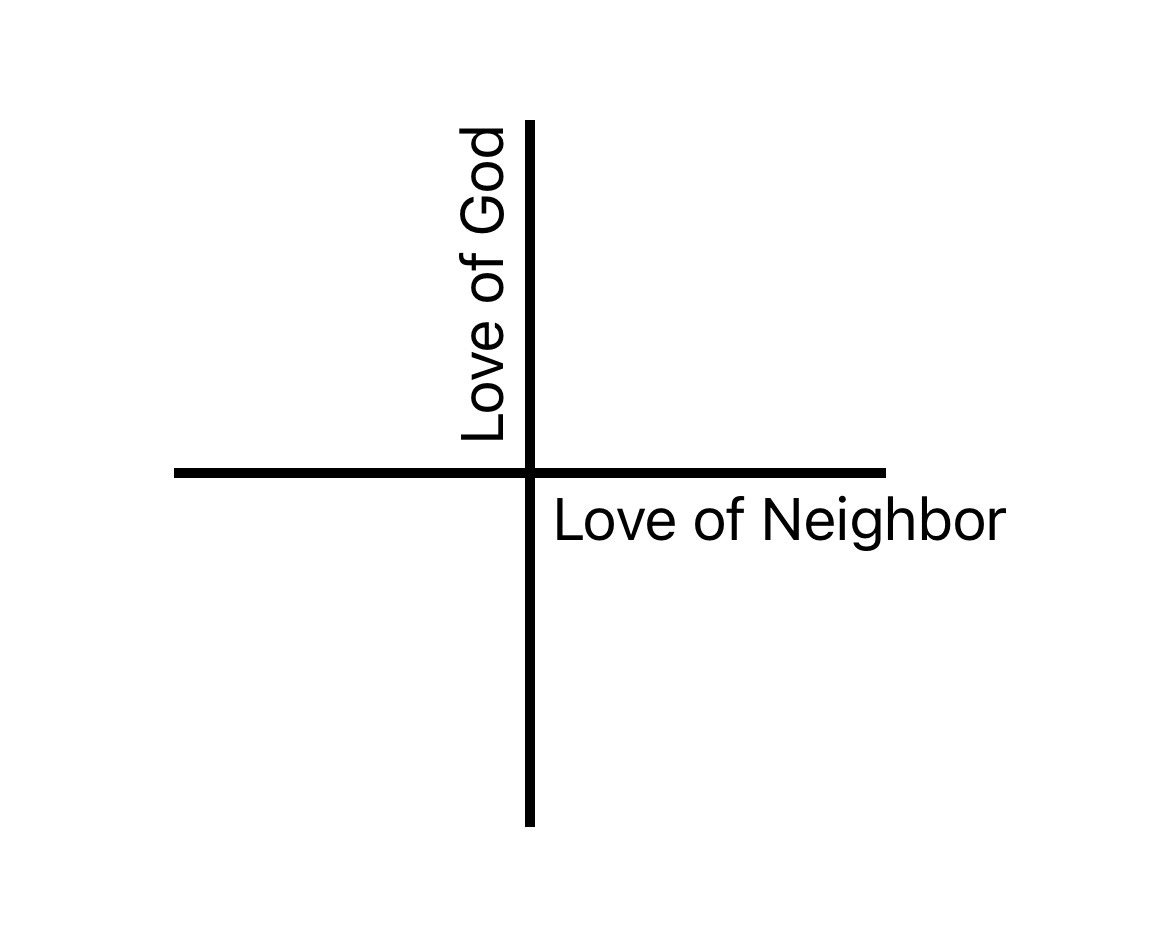
These two laws are not opposed to each other, and we might imagine the commandments as two axes forming a cross. Love of neighbor and love of God grow together (and as they do, so grows the cross we are called to bear). Thus, the existence of love between a man and woman in the resurrection would not be a barrier or distraction to the love of God.
To bring this meditation to a close, I would like to draw attention to the more practical aspects of this mystery. Paul addresses the practical concerns of marriage in his first letter to the Corinthians. The seventh chapter begins with Paul addressing questions from the church regarding marriage.16 In particular, there are two difficult passages which become clarified:
“Defraud ye not one the other, except it be with consent for a time, that ye may give yourselves to fasting and prayer; and come together again, that Satan tempt you not for your incontinency.”17
“Art thou bound unto a wife? seek not to be loosed. Art thou loosed from a wife? seek not a wife. But if thou marry, thou hast not sinned; and if a virgin marry, she hath not sinned. Nevertheless such shall have trouble in the flesh: but I spare you. But this I say, brethren, the time is short: it remaineth, that both they that have wives be as though they had none”18
Paul has, at all times, the resurrection in mind. The Christian is the man who has already died, and the resurrected life has already begun in his inner man. 19 If Paul is to be taken seriously, then the Christian has already been freed from the law of marriage by death. This is the only way that Paul can write “they that have wives be as though they had none.” For the same reason, he recommends that both husband and wife enact their freedom in the form of a period of time devoted to abstinence, prayer, and fasting.20 It is not because their union is bad, but because the freedom of resurrection is better. And perhaps the freedom serves the purpose of making the future union even greater, for Jesus says, “I lay down my life, that I might take it again.”21
Genesis 2:24
Esther 8:8
Exodus 20:14,17
Matthew 5:31
Matthew 5:32
Matthew 22:24-27
Romans 7:1-2
Matthew 22:29
1 Corinthians 6:3
Genesis 19:3
Luke 24:38-43
Daniel 12:1
Ephesians 5:32
This mystical interpretation is not opposed to the ecclesial interpretation of the verse.
John 10:10
Paul also addresses two other topics in this chapter: circumcision (law) and slavery, further strengthening our assertion that marriage falls under the category of “binding”
1 Corinthians 7:5
1 Corinthians 7:27-29
Argued for in detail in Romans 6
It ought to be thoroughly emphasized that this freedom is not used to transgress the law. Paul writes, “Every sin that a man doeth is without the body; but he that committeth fornication sinneth against his own body” (1 Corinthians 6:18). And “so ought men to love their wives as their own bodies” (Ephesians 5:22).
John 10:17
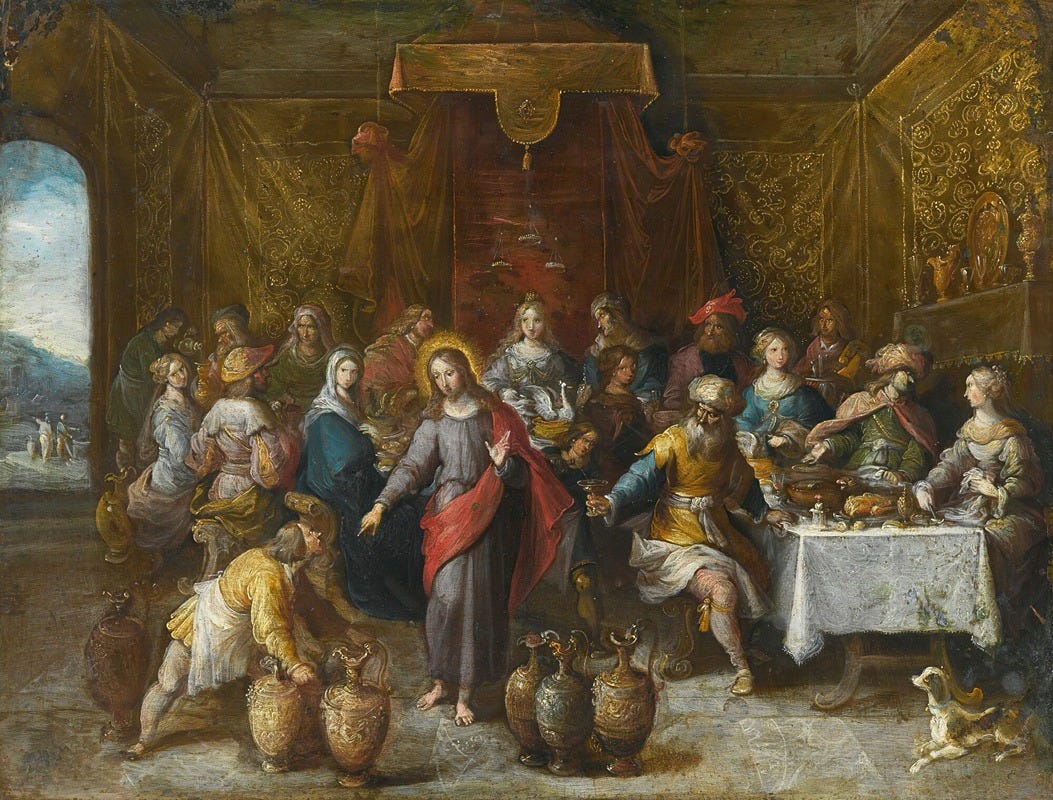
The Marriage Feast at Cana, Frans Francken the Younger
Really good. This has been for some time my read on that passage as well, but I've not heard anyone else lay it out before. The idea that Jesus is speaking of an end to the union of men and women always seemed to me to be too straightforward of an interpretation.
I remember a friend of mine once asked why the woman caught in adultery was spared (he didn't think she should have been stoned to death, but was puzzled as to what principle was being conveyed besides "be forgiving.") The takeaway we agreed on was (in addition to "be forgiving"): you would not want a wife who was faithful only because she was afraid of being stoned to death.